Research Article | | Peer-Reviewed

The Role and Prospect of Emission Trading in the Optimal Allocation of Environmental Resources

Received: 22 October 2024     Accepted: 13 November 2024     Published: 21 November 2024
Views:       Downloads:
Abstract

The emission trading system is an important institutional innovation which effectively uses market mechanisms to improve the efficiency of environmental governance, and plays an important role in exploiting the potential of emission reduction for government and enterprise, which would realize the optimal allocation of environmental resources. The study analyses the design mechanism of emission trading system, the crucial parts including verification of emission rights, paid use for resources, emission trading, reserve and control mechanism, as well as management and incentive policies. Thereby, the current problems of emission trading system in China have been found out, including the deficiency of top-level design, ineffective cohesive mechanism between different systems, inactive trading market, and insufficient supporting policy guarantee policy. Based on the development trend of national policies and the practical problems faced by emission trading, the study proposes four prospects for the emission trading efforts. First, the issuance of guidance documents for deepening the emission trading system at the national level is an important foundation for the development of the emission trading system. Second, convergence between the emission rights trading and the emission permit system is the inevitable trend of the development of the system. Third, working on promoting the construction of a trading system dominated by market mechanisms is the focus of the optimal allocation of resources and environment. Last, establishing and improving relevant supporting mechanisms is an important guarantee for the stable development of the emission rights trading market and the efficient allocation of environmental resources.

Published in Journal of Energy and Natural Resources (Volume 13, Issue 4)
DOI 10.11648/j.jenr.20241304.12
Page(s) 152-159
Creative Commons

This is an Open Access article, distributed under the terms of the Creative Commons Attribution 4.0 International License (http://creativecommons.org/licenses/by/4.0/), which permits unrestricted use, distribution and reproduction in any medium or format, provided the original work is properly cited.

Copyright

Copyright © The Author(s), 2024. Published by Science Publishing Group

Keywords

Emission Trading, Environmental Resources, Policy Research

1. Introduction
The paid use and trading of emissions (hereinafter referred to as "emission trading") system represents a pivotal institutional innovation leveraging market mechanisms to enhance environmental governance effectiveness. In recent years, the CPC Central Committee and the State Council have emphasized the advancement of emission trading in various institutional frameworks, including the establishment of a unified national market, the realization of ecological product values, the deepening of ecological protection compensation, and the improvement of a market-based allocation system for resource and environmental factors. As China dives deeper into its pollution reduction efforts, the potential for conventional pollutants reduction is shrinking, with diminishing marginal effects and heightened challenge in sustaining environmental quality improvements. In this context, the establishment and refinement of the emission trading market system, coupled with the development of an emission reduction mechanism combining administrative and market-based approaches to fully harness the decisive role of the market in resource allocation, holds great significance in motivating governments and enterprises to tap into their emission reduction potential further and foster high-quality economic development.
Emission trading allows various pollution sources within a specific region to exchange emission allowances among themselves through monetary exchanges, on the premise that the total pollutant emissions don't exceed the allowed limit. This innovative approach aims to reduce emissions and protect the environment. The theory behind emission trading roots back to Ronald Coase's assertion that "clearly defined property rights can lead to efficient resource allocation" . First, Coase transformed "transaction costs" into a powerful tool for studying organizational forms and resource allocation efficiency. Second, Coase emphasized the importance of establishing property rights in addressing externalities and proposed a solution of "private property rights plus price mechanism". Moreover, Coase advocated for a shift in analytical approach when tackling externalities, which is considering not only the intended effects of policy changes but also the operational and transition costs of different systems when designing and selecting solutions . Emission trading policies can play a big role in solving externalities of environmental resources utilization. Many scholars have dived deep into emission trading, covering topics such as theoretical foundations , cost-benefit analyses , initial allocation and policy design , market , and global greenhouse gas markets . Emission trading practices have also made headway like the U.S. Acid Rain Program and the EU's Emissions Trading System.
Domestic and foreign research shows a spotlight on the positive impacts of emissions trading on environmental resource allocation efficiency, either directly or indirectly. A study by Markus delves into the implementation costs of allocating environmental resources at both production and emission ends, verifying the efficacy of emissions trading in this regard . Benz al. further unveiled that reasonable approaches to emissions allocation, such as emission rights auctions, significantly enhance the utilization of environmental resources . Researches in China have shown that emissions trading can resolve the "bottleneck" issues arising from misaligned resource allocation in economic development . Wang Jinnan al. proposed that commercialization can facilitate reasonable emissions trading, indirectly promoting the environmental resource allocation across diverse regions . Xu Fang al. argued that emissions trading primarily assigns value to environmental capacity and, through free transferability, effectively mitigates the imbalance in pollutant emissions . Based on the previous studies, this research aims to dissect specific aspects of China's emissions trading practices, seek to identify the mechanisms at play within each segment that contribute to optimal environmental resource allocation, and summarize the prevalent challenges faced by emissions trading, as well as offer strategic responses and future outlooks.
2. The Role of Emission Trading in the Optimal Allocation of Environmental Resources
2.1. Mechanism Design
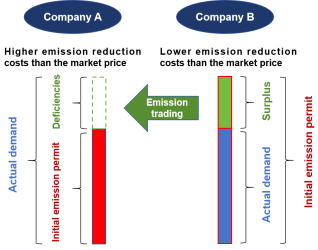
The Emissions trading stands as a pivotal initiative in building ecological environmental governance system, modernizing governance capabilities and propelling economic growth towards higher quality. Its fundamental goal is to minimize society's overall emission reduction costs. To break down how it works : First, a comprehensive and accurate emissions inventory of all participating enterprises within a specific region needs to be compiled. Based on the inventory, environmental quality targets can be set up and the region's environmental capacity assessed. Next, fair and reasonable methods (e.g., GPS-based allocation, auctions) can be leveraged to verify emission rights to pollution sources, and an emissions trading market can be established where emission allowances can be freely and legally bought and sold, as illustrated in Figure 1. When Company A faces higher emission reduction costs than the market price, it can purchase additional emission allowances through the market if it falls short of emission rights. Conversely, Company B, with lower emission reduction costs than market price, can sell surplus allowances by reducing emissions, thus earning economic benefits. This trading space exists and sustains precisely because of varying emission reduction costs among enterprises.
The United States has carried out emissions trading for the longest time in the world, with the most extensive industry, and the most abundant subject matter. Since the 1970s, the United States has applied emission trading to the management of air pollution sources and river pollution sources. Especially, after 1990, the United States carried out emission trading in the field of SO2 based on the acid rain program, and obtained considerable economic and environmental governance benefits. Between 1978 and 1998, the average concentration of SO2 in the air in the United States fell by more than 53%, and between 1990 and 2000, the emissions of SO2 in the United States fell by 25%. Emissions trading allowed the United States to complete the task of acid rain control three years ahead of schedule, and also saved at least 60% of the pollution control costs .
Figure 1. Emission trading design mechanism.
2.2. Emission Trading Practices in China
Since the 1980s, China has embarked on an exploratory journey in emissions trading, initially featuring simple "company-to-company" transactions. In the 1990s, preliminary pilot programs for air pollutant emissions trading were launched. Between 2007 and 2013, the Ministry of Finance, the former Ministry of Environmental Protection, and the National Development and Reform Commission approved emissions trading pilots in 11 provinces, including Jiangsu, Zhejiang, Tianjin, Hubei, Hunan, Shanxi, Inner Mongolia, Chongqing, Hebei, Shaanxi, and Henan, as well as Qingdao City. During this phase, emissions trading pilots were conducted with predefined total emission caps at the regional level, and local emissions trading policy frameworks had taken shape. In 2014, the General Office of the State Council issued the "Guiding Opinions on Further Promoting the Pilot Work of Paid Use and Trading of Emissions Rights" (Issued by General Office of the State Council [2014] No. 38), ending the situation that the pilots work without uniform norms. Guided by this document, regions gained clarity on the framework and key points of emissions trading policies, actively and orderly advancing their pilot efforts. By 2017, as the term of the No. 38 document expired, the establishment of emissions trading policies in pilot regions was largely wrapped up. However, subsequent arrangements for "completing pilot work" were yet to be defined, ushering these regions into a phase of independent exploration.
Zhejiang Province is among the most active area for emission trading in China. Since the pilot of emission trading in 2009, Zhejiang has issued more than 200 emission rights-related policy documents, of which 26 have been issued at the provincial level, and 175 have been issued around the country, establishing and improving the paid use and trading system of emission rights. At present, more than 30,000 industrial pollutant discharge units in the province have been involved in paid use of emission rights and market-based transaction. Besides, pollutant discharge reserve accounts at provincial, municipal and county levels have been established, and green financial mechanisms such as emission right leasing and pledge loans have been explored. In terms of environmental benefits, the environmental access threshold for heavy pollution projects has been further improved, objectively limiting the high-pollution and energy-consuming projects and new projects in industries with excess capacity, which will effectively lead environmental resources to low-pollution, low-energy consumption, and high value-added industries, and contribute to pollution reduction and environmental quality improvement. In terms of economic benefits, on the one hand, the government have significantly increased non-tax revenue, but also opened up high-quality new financing channels for enterprises.
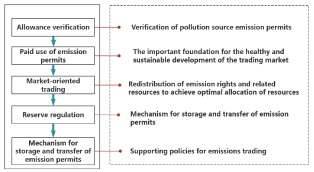
Figure 2. Key aspects of emission trading in China.
Currently, China's emissions trading system has evolved into a comprehensive framework, including key elements such as emission allowances allocation, paid use, market trading, reserve regulation, management, and incentives. As illustrated in Figure 2, quota allocation represents the initial distribution of resource use rights and pollution control responsibilities, mirroring the delineation of property rights in economics, and procured through paid means. Market trading, on the other hand, facilitates the redistribution of emission rights and leads to optimized resource allocation, which involves aspects such as trading prices, rules, and procedures. Clear systems and regulations are crucial to protect the market from arbitrary regulatory interventions, fostering a stable market outlook among market participants, and mitigating irrational market behavior, which is fundamental for a stable and healthy market. Reserve regulation serves as an essential supporting and regulatory mechanism for emissions trading, including the storage and sale of emissions allowances. It not only ensures effective management of emissions allowances but also acts as a powerful lever in market regulation, paving the way for a healthy and orderly emissions trading market. Management and incentive policies are supporting policies of emissions trading. Effective supervision is necessary to ensure that policy implementation stays on track, preventing deviations from policy objectives due to cognitive limitations of executors or differing interests between executors and policymakers. Incentive policies, including leveraging financial mechanisms, subsidies, and other benefits, are pivotal in activating the asset attributes of emissions rights and encouraging enterprises to engage in emissions trading.
2.2.1. Allowance Verification
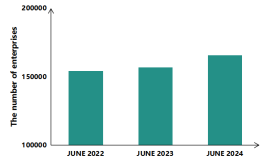
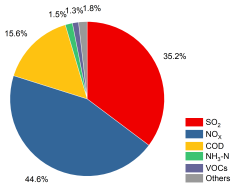
At present, China lacks a unified method for determining pollutant emission rights for different enterprises. As the reform in total emission control and emission permit systems roll out, effective integrations among emission right verification, emission permitting systems, and environmental impact assessments. are actively explored. For initial emission permits, emission units in Hebei, Inner Mongolia, Fujian, Hubei, Shaanxi, and Dongguan City in Guangdong Province, which are currently involved in permit management, have been verified emission rights based on the total emission volume allowed by their emission permits. Jiangsu and Zhejiang Provinces determine permits with the smallest value of calculated result from technical specifications for emission permits, approved quantities in environmental impact assessments, and calculated value under locally controlled total emission requirements. When it comes to new emission rights, projects undergoing new construction, renovation, or expansion across regions have their new emission rights indicators determined based on the pollutants emissions approved in their environmental impact assessments. In terms of specific calculation methods, the emission performance approach takes center stage, comprehensively considering factors such as production processes, energy efficiency, pollution control measures, and the overall production status and pollution treatment capabilities of enterprises. This approach serves dual purposes. It encourages low-performing enterprises to upgrade their practices, freeing up environmental resources previously tied up in outdated facilities. On the other hand, it indirectly raises the bar for environmental entry of new projects, motivating enterprises to voluntarily adopt more efficient facilities to reduce long-term emission rights costs. Thereby efficient allocation of environmental resources can be achieved. According to the situations of emission rights verification over the past three years in China, a steady growth in the number of verified enterprises can be observed. As of June 2024, 16 pilot provinces had embarked on initial emission rights verification, with more than 150,000 enterprises involved. The total verified quantities of four major pollutants, including SO2, NOX, COD, and NH3-N, exceed 6 million tons. Specifically, sulfur dioxide, nitrogen oxides, and COD account for 35.2%, 44.6%, and 15.6% respectively, of the total verified pollutants.
Figure 3. The number of enterprises approved for cumulative emission trading rights nationwide from 2022 to 2024.
Figure 4. Verified proportion of various pollutants.
2.2.2. Paid Use of Emission Rights
Paid use of emission rights stands as a vital component of the emission rights trading system, forming the solid foundation for the healthy and sustainable development of emission rights markets. The research reveals that a total of 17 provinces in China have implemented paid use of emission rights. Among them, Zhejiang, Hunan, and Chongqing have successfully implemented and completed the fee collection, and Hebei plans to finish its collection by the end of 2024. Ningxia and Anhui have introduced paid use of emission rights but have yet to complete comprehensive fee collection. Guangdong, Inner Mongolia, and Shandong have implemented paid use in selected regions or industries, or have adopted a voluntary paid use system. On the other hand, Fujian, Shaanxi, Jiangsu, and Jiangxi allow existing enterprises to acquire emission rights for free, but require to pay the fee prior to sale. Research has shown that enterprises that acquire emission rights through paid means have generally adopted the concept that environmental resources are valuable. In the process of resource utilization, the valuable have also developed a consciousness of conservation and proactive emission reduction. Moreover, the models of partially paid, voluntary paid, and pay the fee prior to sale are transitional approaches for shift from unpaid to paid use of emission rights, which can accommodate more enterprises to engage in emission rights trading, thereby assisting the optimal allocation of environmental resources. figure should have a concise caption describing what it represents.
Table 1. Summary of the situations of paid use of emission rights in pilot regions with substantial tradings in the past three years.

Province

Paid use landscape

Zhejiang

Paid use.

Hebei

Paid use, plans to complete the collection by the end of 2024.

Fujian

Existing enterprises are free of charge, and paid usage fees need to be paid when selling emission rights.

Hunan

Paid use.

Shaanxi

Paid use, suspension of fees.

Ningxia

Paid use, incomplete collection, paid usage fees need to be paid when selling emission rights and mortgaging loans with emission rights.

Guangdong

Paid use in Dongguan City. voluntary paid in Foshan City, and paid usage fees need to be paid when selling emission rights.

Jiangsu

and paid usage fees need to be paid when selling emission rights.

Jiangxi

and paid usage fees need to be paid when selling emission rights.

Chongqing

Paid use

Inner Mongolia

Paid use within thermal power enterprises

Shandong

Transition from gratuitous to paid use.

Anhui

Paid use, incomplete collection.

Heilongjiang

Paid use, incomplete collection

Gansu Province

Paid use

Guizhou

Paid use

2.2.3. Market Transaction
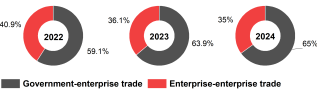
In China, emissions trading includes transactions between governments and enterprises, as well as between enterprises themselves. Government-enterprise trade primarily involve new, renovated, or expanded projects purchasing additional emission rights from the government. This approach effectively curbs the incremental rise in pollutant emissions and helps directing environmental resources towards industries and regions with competitive advantages. However, because the government-enterprise trade lack the ability to incentivize enterprises to reduce emissions or revitalize unused emission rights as assets, and highly sensitive to governmental actions, it cannot be recognized as true market-oriented transaction. Enterprise- enterprise trade harness the power of market price to reflect the genuine value of environmental resources. By capitalizing on the disparities in pollution treatment costs among enterprises and leveraging market mechanisms, enterprise-enterprise trade can achieve a truly rational allocation of resources. A unique advantage of enterprise-enterprise trade is that new, renovated, or expanded enterprises can purchase surplus emission capacity from other emission rights holders, which would help to collect and integrate the idle, scattered, fragmented, and inefficiently used emission rights, thereby ensuring the optimal use of existing emission reduction quotas and supporting high-quality economic and social development.
Figure 5. The cumulative amount and composition of market transactions in China from June 2021 to June 2024.
2.2.4. Reserve Regulation
As a supporting system of the emissions trading framework, the government reserve and release mechanism for emission rights not only acts as a crucial lever to balance supply and demand in the emissions trading market, but also guarantees necessary emission allowances for vital government projects. The study collects the design and implementation of emission rights reserve mechanisms across China since the inception of emission rights trading pilot programs. A total of 12 provinces, including Hebei and Shanxi, have established comprehensive systems for emission rights reserves, utilizing methods such as reservation, free withdrawal, and paid repurchases to store emission rights allowances. These provinces have also clarified the preconditions and procedures for transferring emission rights. Six provinces, including Zhejiang and Inner Mongolia, have substantially engaged in repurchasing activities. As of June 2024, nationwide government repurchases of emission permits had surpassed 2,000 transactions. Governments leverage market-based mechanisms to dynamically regulate the emission rights trading market by repurchasing emission rights, releasing emission rights allowances into the market, and transferring standby allowances. In this way, they're playing a pivotal role in macroeconomic control, not only motivating enterprises to engage in the emission rights trading market but also re-energizing the market to ensure the optimal allocation of environmental resources.
2.2.5. Management and Incentive Policies
Uniform and scientifically data management, coupled with stringent and meticulous supervision and enforcement, alongside efficient and convenient support ability, are the cornerstone of a robust and well-rounded emissions trading system. This study has found that, currently, 14 provinces and 2 cities have set up specialized agencies dedicated to emissions trading operations. Furthermore, 19 provinces have launched comprehensive trading platforms that integrate data verification, allowance subscription, transaction management, buying and selling, and information dissemination. The emissions trading financial mechanism stands out as a pivotal incentive policy of the "paid use and trading of emissions rights". It offers a fresh perspective on addressing the pervasive issue of "difficult and expensive financing" for enterprises, while endowing emissions rights with a deeper market value. According to the survey, 10 provinces, including Zhejiang and Shanxi, have implemented emissions-rights-based mortgages, effectively alleviating cash flow pressures on businesses. Additionally, six provinces, such as Zhejiang and Hubei, have established emissions rights leasing mechanisms among enterprises, putting emissions allowances sitting idle into good use.
3. Problems and Prospects
Research reveals that as the continuous improvement of ecological quality ventures into more challenging territories, the room for administrative measures in reducing emissions is tightening. Regions across China are increasingly recognizing the scarcity of environmental resources and the role of total quantity indicators as production factors, highlighting the importance of market mechanisms in emissions trading markets. Given reforms in total amount of emission control and pollution permit systems, as well as the changes in the situation of ecological and environmental protection, the existing emissions trading framework is struggling to meet current environmental management demands, grappling with issues such as inadequate top-down design, unsmooth integration with other regulatory frameworks, thus leading to prevalent on-the-fence attitude among regions. Furthermore, the nationwide emissions trading market is sluggish, with the business-to-business trading platform yet to be fully established. Additionally, regions are confronted with insufficient environmental monitoring and enforcement capabilities, which hinders the healthy and stable development of trading markets. In this context, the development of emissions trading systems hinges critically on the research and issuance of national-level guidance documents aimed at deepening this institutional framework. As the pollution permit system solidifies its role as the cornerstone of fixed pollution source management in China, environmental regulatory mechanisms, including emissions trading, are poised to transition and evolve in alignment with this system. Based on this, the focus for the future lies in advancing the construction of a market-mechanism-led trading system, which will be pivotal for emissions trading and the optimal allocation of resources and the environment. Establishing and refining complementary mechanisms, such as enhancing the application of financial policies to mobilize and direct more social capital into eco-environmental protection investments, and improving the monitoring and enforcement mechanisms for corporate pollutant emissions, are essential guarantees for the stable development of the emission trading market and the efficient allocation of environmental resources.
Abbreviations

SO2

Sulfur Dioxide

NOX

Nitrogen Oxides

COD

Chemical Oxygen Demand

NH3-N

Ammonia Nitrogen

VOCs

Volatile Organic Compounds

Acknowledgments
This article represents one of the key milestones of the fiscal budget project titled "Research on Policy Design for the Construction and Implementation of Environmental Governance Systems: Paid Use and Trading System of Emission Rights".
Author Contributions
Haixu Zhang: Writing – original draft
Chunlai Jiang: Project administration, Writing – review & editing
Jinying Huang: Formal Analysis, Data curation
Yaolin Wang: Investigation
Zhiguo Duan: Conceptualization
Funding
This work is supported by the fiscal budget project titled "Research on Policy Design for the Construction and Implementation of Environmental Governance Systems: Paid Use and Trading System of Emission Rights".
Conflicts of Interest
The authors declare no conflicts of interest.
References
[1] Wang Jinnan, Zhang Bing, Wu Yueying, al. Paid use and trading of emission rights in china: practice and prospects [J] Environmental Protection, 2014 42(14): p. 22-25.
[2] Wu Jian, Ma Zhong The theoretical contribution of Coase's theorem to emissions trading policies, Journal of Xiamen University (Philosophy and Social Sciences Edition) [J], 2004(03): p. 21-25.
[3] Wang Jinnan, Dong Zhanfeng, Yang Jintian, al. The latest practice and prospect of emissions trading system [J] Environmental Economics 2008(10): p. 31-45
[4] Yu Jie, Zhou Weiduo, Jiang Jinxing. Emission trading: theoretical introduction and localization practice [J] Journal of China University of Geosciences: Social Sciences Edition, 2014, 14(6): 9.
[5] Liu Congping. On the determinants of economic benefits in environmental pollution control [J] Environmental Science and Management, 2006, 31(2): 4.
[6] Zhao Haixia. An analysis of the optimal design of emissions trading under transaction costs [J] Environmental Science and Technology, 2006, 29(5): 45-47.
[7] Zhao Wenhui. A review of theoretical research on initial emission rights allocation [J] Industrial Technology and Economics, 2008, 27(8): 3.
[8] Zheng Feifei, Jia Ailing Related issues and improvement of initial allocation of emission rights [J] Journal of China Environmental Management Cadre College, 2016(3): 4.
[9] Duan Jiali, Zhang Baohui, Chang Chang, al. Exploration and research on the establishment of emission trading market [J] Environment and Sustainable Development, 2020, 45(2): 3.
[10] Du Qunfei. Research on the problems and countermeasures of the current marketization mechanism of emission trading [J] Ecological Economy, 2015, 31(1): 6.
[11] Lv Zhongmei, You Mingqing. The path to improving the carbon market system under global weak aggregate constraints: from the perspective of global greenhouse gas total control Journal of Zhejiang University (Humanities and Social Sciences Edition), 2023(11): 28-39.
[12] Markus Sahman, Lars Zetterberg. Options for Emission Allowance Allocation Under the EU Emission Trading Directive [J]. Mitigation and Adaptation Strategies for Global, 2007, 6(8): 23-28.
[13] Benz, Sturm, Bodo, Andreas. Auctioning of CO2 Emission Allowances in Phase 3 of EU Emissions Trading Scheme [J]. Discussion Papers, 2009, 10(2): 37-63.
[14] Verschuuren J M, Fleurke F M. Effective auctioning of European Union emissions trading scheme allowances in a globalized market for carbon dioxide [J]. IEEE International Engineering Management, 2013, 11(9): 48-59.
[15] Lin Hong. Emissions trading: solving the bottleneck problem in economic development, Environmental Economics, 2004, (03): 29-34.
[16] Xu Fang, Liu Fu, Tian Yiwen. A brief analysis of emissions trading [J] Environmental Protection, 2010, 6(28): 28-35.
[17] Bai Li. Development of emission trading theory and practice. 1 ed. Zhejiang Province. Zhejiang Gongshang University Press, 2019, 96.
[18] Hu Caijuan. The evolution of emission trading in the United States, basic experience and inspiration for China [J] Reform of Economic System, 2017(03): 164-169.
Cite This Article
  • APA Style

    Zhang, H., Jiang, C., Huang, J., Wang, Y., Duan, Z. (2024). The Role and Prospect of Emission Trading in the Optimal Allocation of Environmental Resources. Journal of Energy and Natural Resources, 13(4), 152-159. https://doi.org/10.11648/j.jenr.20241304.12

    Copy | Download

    ACS Style

    Zhang, H.; Jiang, C.; Huang, J.; Wang, Y.; Duan, Z. The Role and Prospect of Emission Trading in the Optimal Allocation of Environmental Resources. J. Energy Nat. Resour. 2024, 13(4), 152-159. doi: 10.11648/j.jenr.20241304.12

    Copy | Download

    AMA Style

    Zhang H, Jiang C, Huang J, Wang Y, Duan Z. The Role and Prospect of Emission Trading in the Optimal Allocation of Environmental Resources. J Energy Nat Resour. 2024;13(4):152-159. doi: 10.11648/j.jenr.20241304.12

    Copy | Download

  • @article{10.11648/j.jenr.20241304.12,
      author = {Haixu Zhang and Chunlai Jiang and Jinying Huang and Yaolin Wang and Zhiguo Duan},
      title = {The Role and Prospect of Emission Trading in the Optimal Allocation of Environmental Resources
    },
      journal = {Journal of Energy and Natural Resources},
      volume = {13},
      number = {4},
      pages = {152-159},
      doi = {10.11648/j.jenr.20241304.12},
      url = {https://doi.org/10.11648/j.jenr.20241304.12},
      eprint = {https://article.sciencepublishinggroup.com/pdf/10.11648.j.jenr.20241304.12},
      abstract = {The emission trading system is an important institutional innovation which effectively uses market mechanisms to improve the efficiency of environmental governance, and plays an important role in exploiting the potential of emission reduction for government and enterprise, which would realize the optimal allocation of environmental resources. The study analyses the design mechanism of emission trading system, the crucial parts including verification of emission rights, paid use for resources, emission trading, reserve and control mechanism, as well as management and incentive policies. Thereby, the current problems of emission trading system in China have been found out, including the deficiency of top-level design, ineffective cohesive mechanism between different systems, inactive trading market, and insufficient supporting policy guarantee policy. Based on the development trend of national policies and the practical problems faced by emission trading, the study proposes four prospects for the emission trading efforts. First, the issuance of guidance documents for deepening the emission trading system at the national level is an important foundation for the development of the emission trading system. Second, convergence between the emission rights trading and the emission permit system is the inevitable trend of the development of the system. Third, working on promoting the construction of a trading system dominated by market mechanisms is the focus of the optimal allocation of resources and environment. Last, establishing and improving relevant supporting mechanisms is an important guarantee for the stable development of the emission rights trading market and the efficient allocation of environmental resources.
    },
     year = {2024}
    }
    

    Copy | Download

  • TY  - JOUR
    T1  - The Role and Prospect of Emission Trading in the Optimal Allocation of Environmental Resources
    
    AU  - Haixu Zhang
    AU  - Chunlai Jiang
    AU  - Jinying Huang
    AU  - Yaolin Wang
    AU  - Zhiguo Duan
    Y1  - 2024/11/21
    PY  - 2024
    N1  - https://doi.org/10.11648/j.jenr.20241304.12
    DO  - 10.11648/j.jenr.20241304.12
    T2  - Journal of Energy and Natural Resources
    JF  - Journal of Energy and Natural Resources
    JO  - Journal of Energy and Natural Resources
    SP  - 152
    EP  - 159
    PB  - Science Publishing Group
    SN  - 2330-7404
    UR  - https://doi.org/10.11648/j.jenr.20241304.12
    AB  - The emission trading system is an important institutional innovation which effectively uses market mechanisms to improve the efficiency of environmental governance, and plays an important role in exploiting the potential of emission reduction for government and enterprise, which would realize the optimal allocation of environmental resources. The study analyses the design mechanism of emission trading system, the crucial parts including verification of emission rights, paid use for resources, emission trading, reserve and control mechanism, as well as management and incentive policies. Thereby, the current problems of emission trading system in China have been found out, including the deficiency of top-level design, ineffective cohesive mechanism between different systems, inactive trading market, and insufficient supporting policy guarantee policy. Based on the development trend of national policies and the practical problems faced by emission trading, the study proposes four prospects for the emission trading efforts. First, the issuance of guidance documents for deepening the emission trading system at the national level is an important foundation for the development of the emission trading system. Second, convergence between the emission rights trading and the emission permit system is the inevitable trend of the development of the system. Third, working on promoting the construction of a trading system dominated by market mechanisms is the focus of the optimal allocation of resources and environment. Last, establishing and improving relevant supporting mechanisms is an important guarantee for the stable development of the emission rights trading market and the efficient allocation of environmental resources.
    
    VL  - 13
    IS  - 4
    ER  - 

    Copy | Download

Author Information
  • Research Center for Emission Trading and Reduction, Chinese Academy of Envoronmental Planning, Beijing, China

    Biography: Haixu Zhang is an associate researcher at Chinese Academy of Environmental Planning, Research Center for Emission Trading and Reduction. She completed her PhD in Enviromental Sciences from University of Chinese Academy of Sciences in 2018. She has participated in research on emission trading and pollutant reduction in recent years. Her 10+ papers have been published, and a patent for an invention is granted.

    Research Fields: Emisson trading, pollutant reduction, air pollution, pollution mechanism, pollution control policy, source apportionment.


  • Research Center for Emission Trading and Reduction, Chinese Academy of Envoronmental Planning, Beijing, China

    Biography: Chunlai Jiang is a researcher, works for Chinese Academy of Environmental Planning as Director of the Air Pollution Source Research Office, Director of the Dispatching Room of the Situation Analysis and Planning Evaluation Center, and Director of the Emission Trading and Emission Reduction Research Center. She completed her PhD in Enviromental Sciences from Chinese Academy of Sciences in 2008. She has been part of the top-level design of multiple environmental planning and policies in China since the 11th Five Year Plan, playing an important role in the establishment of air pollution source management system in China during the 12th Five Year Plan, 13th Five Year Plan, and 14th Five Year Plan period. She has led or participated as a core technician in more than 30 scientific research projects, including serving as head of 10 national level projects such as the National Key Research and Development Plan Key Projects and Atmospheric Research Special Projects.

    Research Fields: Environmental planning, pollution control policy, energy conservation and emission reduction planning, carbon emission trading, pollution reduction and carbon emissions cut.

  • Research Center for Emission Trading and Reduction, Chinese Academy of Envoronmental Planning, Beijing, China

    Biography: Jinying Huang is an engineer at Chinese Academy of Environmental Planning, Research Center for Emission Trading and Reduction. She completed her Master degree in Environmental Engineering from South China University of Technology in 2018. She has participated in works on total emission reduction, emission rights trading, pollution control battle scheduling assessment, with several papers published.

    Research Fields: Total emission reduction, emission rights trading, pollution control battle scheduling assessment, carbon emission trading, pollution control policy.

  • Research Center for Emission Trading and Reduction, Chinese Academy of Envoronmental Planning, Beijing, China;College of Chemistry, Zhengzhou University, Zhengzhou, China

    Biography: Yaolin Wang is a postgraduate student at Zhengzhou University, majoring in Environmental Sciences. He has participated in research on emission trading and pollutant reduction mainly in thermal power industry in recent years.

    Research Fields: Emisson trading, pollutant reduction, pollution control policy, pollution reduction and carbon emissions cut, carbon emission trading.

  • Emissions Trading Section, Eco-environment Low Carbon Development Center of Inner Mongolia, Hohhot, China

    Biography: Zhiguo Duan is an senior engineer at Eco-environment Low Carbon Development Center of Inner Mongolia, Director of Emissions Trading Section. He has been engaged in environmental monitoring, pollution source survey, total emission reduction, emission trading, emission permits, soil survey, climate change response, pollution prevention and control and other business work.His 10+ papers have been published, 2 books have been published, and a patent for an invention is granted.

    Research Fields: Environmental monitoring, pollution source survey, total emission reduction, emission trading, emission permits, soil survey, climate change response, pollution prevention and control.