Research Article | | Peer-Reviewed

Impact of Energy Consumption from Renewable Energy Sources on Economic Growth: Evidence from Nigeria

Received: 25 August 2024     Accepted: 18 September 2024     Published: 29 October 2024
Views:       Downloads:
Abstract

This study examines the impact of renewable energy consumption and electricity tariff on the economy of Nigeria. The study considers the casual relationship and vector decomposition between various renewable energy sources (solar, hydro and biomass), electricity price and Gross domestic product (GDP) using an unrestricted vector error correction model (VECM). In addition, other robust econometric techniques were applied to the time series of GDP, electricity price and energy consumption from renewable energy sources from 1980 to 2021. The findings indicated a 1% increase in biomass consumption causes increase in GDP by 0.14% in the long-run. Mixed result in the short-run with the difference in the log value of the current lag of solar and bio electricity consumption having positive impact on GDP. The coefficient of the Error Correction Model (ECM) was negative (-0.49) and statistically significant indicating that short-run change from the long-run equilibrium is corrected by 49% annually. Unidirectional causality from GDP to solar electricity consumption. Solar, hydro, biomass and electricity price explain 1.4%, 0.4% 2.2% & 12% respectively of fluctuations in GDP in the long-run. The study results demonstrates that regulations need to be put in place to control the adverse effect of consuming biomass on the environment which could cause mixed impact on gross domestic product in the short run whereas, policies to foster development of solar projects could impact positively on GDP and alleviate the electricity supply deficiency in Nigeria.

Published in Journal of Energy and Natural Resources (Volume 13, Issue 4)
DOI 10.11648/j.jenr.20241304.11
Page(s) 138-151
Creative Commons

This is an Open Access article, distributed under the terms of the Creative Commons Attribution 4.0 International License (http://creativecommons.org/licenses/by/4.0/), which permits unrestricted use, distribution and reproduction in any medium or format, provided the original work is properly cited.

Copyright

Copyright © The Author(s), 2024. Published by Science Publishing Group

Keywords

Economic Growth, Renewable Energy, Electricity Consumption, Electricity Price, GDP, Econometrics

1. Introduction
Energy is an important resource for sustainable development. Energy consumption of a nation reflects its growth. With civilization continuously growing and the standard of living improving, the demand for power has increased greatly. As mentioned in, there is constant depletion in energy and any disturbance in the supply of non- renewable energy will in turn affect non-renewable-dependent activities and nations, and as such, there are serious risks associated with the price of energy. The International Energy Agency reports that current trends in energy supply are still economically, environmentally, and socially unsustainable. Therefore, a lot of countries are challenged with energy security and there is a new demand for renewable energy. Nigeria is blessed with numerous natural resources both renewable and non-renewable. Despite the immense natural resources bestowed in Nigeria in the form of natural gas, oil, and coal, the government is still unable to give a long-term solution to the power sector problem which is plagued by inefficiencies and insufficient transmission infrastructure.
The economic performance of a nation can be measured using Gross Domestic Production (GPD). Using the expenditure approach, GDP can be said to be the sum of all consumption expenditure, investment expenditure, government expenditure and net export, with importations impacting negatively on the GDP. GDP is a crucial metric for assessing the overall economic health and growth of a nation. It helps policymakers, economists, and investors understand the size of the economy, track changes in economic activity, and formulate policies for sustainable development.
Nigeria loses about 13 bn/year USD on imported self-generating plants for electricity , and even much more if the fuels imported to run these self-generating plants are accounted for due to the state of the Nigerian refineries. This is not only to the dismay of the economy, but also to the people as these generators cause pollution and health problems to the residents. Recently, there has been a bill to stop importation of these generators, but to what end will this be as the Nigerian power sector is under-performing as the year goes by even with the current restructuring, the issues concerning transmission and distribution losses continue.
Shahid et al in their research “Impact of Electricity Consumption on Economic Growth: An Application of Vector Error Correction Model and Artificial Neural Networks” used the dataset of the annual interval, starting from 1961 to 2015. Utilizes the Johansen Cointegration (JC) approach to find a long-run relationship along with a Vector Error Correction Model (VECM) methodology to identify equilibrium nexus between electricity consumption and economic growth in Pakistan. The JC approach finds the long-run relationship between economic growth, electrical consumption, electrical generation, and electricity shortage. VECM methodology reveals the short-run as well as a long-run nexus among the variables.
Jacob and Viviana estimated the elasticity of the long-run relationship between energy consumption and GDP for 10 countries in Latin America from 1971 to 2007. The authors employed panel cointegration test to determine if such a long-run relationship exists, and Westerlund's (2006) cointegration test for panel data is used to estimate the slopes of the long-run relationship variables. The result shows that cointegration between the two variables and a bidirectional relationship is found to exist between GDP and energy consumption in both directions and that there is a positive significant relationship between GDP and energy consumption.
Nigeria is the 11th largest producer of oil in the world with a production of 1.8 million barrels per day. 85% of government revenue is gotten from oil revenue which also accounts for 1/5 of GDP and 90% of export incomes. However, the impact on the country’s power sector has been little or nothing.
About 55% of the total Nigerian population do not have access to electricity and those who have access are challenged with power supply irregularities caused by systematic issues such as the supply of gas, power generation, transmission, and distribution. Therefore, extra support must be available to complement these mishaps. With the current developments in renewable technology, renewable energy sources can be harnessed to complement Nigeria’s electricity sector.
2. Literature Review
The impact of renewable energy consumption on GDP is a complex and multifaceted topic. While it can contribute to economic growth through various channels, the extent of its impact depends on factors such as the scale of adoption, investment, and the overall energy landscape. The widespread adoption of renewable energy can stimulate economic growth by creating jobs in manufacturing, installation, and maintenance of solar infrastructure . Solar power can lead to reduced energy costs for businesses, freeing up resources that can be redirected to other productive sectors, thus contributing to GDP growth . Reliable and affordable solar power can enhance the productivity of industries and businesses, making them more competitive in the global market . The reduction of environmental and health costs associated with traditional energy sources through the adoption of solar power can indirectly contribute to GDP by improving overall public health and reducing healthcare expenditures . Solar power projects often require substantial investment, contributing to infrastructure development. Increased investment in the renewable energy sector can have positive spillover effects on the overall economy
Asafu-Adjaye explored the intricate relationship between energy consumption, energy prices, and economic growth in Asian developing countries. The study employs a time series analysis to investigate the long-term dynamics of these variables. By doing so, it contributes valuable insights into how changes in energy consumption and prices impact the economic development of Asian nations. The findings from this study are crucial for policymakers and researchers aiming to understand the complex interplay between energy factors and economic growth in the context of developing economies.
Lee and Chang revisited the relationship between energy consumption and GDP, utilizing a panel analysis that includes both developed and developing countries. The study contributes to the ongoing discussion on the energy-GDP nexus by considering a diverse set of countries. The panel analysis allows for a nuanced understanding of how different economic contexts may influence the relationship between energy consumption and economic growth. Policymakers and researchers can benefit from the insights provided in this study to formulate energy policies that align with the specific needs and conditions of both developed and developing nations.
Wolde-Rufael focused on the relationship between electricity consumption and economic growth in 17 African countries, using a time series analysis. The study provides a nuanced understanding of how electricity usage influences the economic development of these nations. By considering the unique context of African countries, the research sheds light on the potential contributions of electricity to economic growth in a region that faces diverse challenges. The findings are valuable for policymakers and stakeholders interested in enhancing energy infrastructure and stimulating economic progress in African nations. Apergis and Payne examined the relationship between renewable energy consumption and economic growth in a panel of OECD countries. By employing panel data analysis, the study provides a comprehensive perspective on how the adoption of renewable energy sources may impact the economic development of industrialized nations. The findings are relevant for policymakers aiming to balance economic growth with sustainable energy practices, offering insights into the potential of renewable energy to drive economic progress in advanced economies.
Nwosa and Akinbobola used pairwise causal relationship method of causality to investigate aggregate energy consumption and sectoral real output in Nigeria for the period between 1980 and 2010. The study adopted unit root test, Engel and Granger cointegration approach, and there was no cointegration found among the variables, and the estimates were analyzed using bivariate Vector auto Regressive (VAR) Granger causality approach. The analysis found a bidirectional causality between aggregate energy consumption and agricultural output and unidirectional causality ran from real service output to aggregate energy consumption. Chitedze et al examined the extent at which electricity consumption (EC) has contributed to real sector performance, to identify energy-dependent sectors of the economy for appropriate sector-specific policy interventions and to avoid energy conservation policies that may retard the growth of the real sector and economic growth in general. The authors used time series data, covering the period between 1981 and 2015. Various time series econometric analyses such as unit root test for stationarity and vector autoregressive and vector error correction models were used to establish the long-run and short-run cointegration relationship among the variables. The findings were that energy consumption displays insignificant impact on manufacturing sector output, as well as agriculture and service outputs. The empirical result from causality test suggests a unidirectional causality running from agriculture to energy consumption, as well as service sector to energy consumption, whereas bidirectional causality runs between energy consumption and manufacturing sector.
Apergis and Payne used panel data analysis to investigate the relationship between renewable energy consumption and economic growth in Central America. Panel cointegration and causality tests may have been employed to assess the long-run dynamics. By focusing on renewable energy consumption, the study contributes to the sustainability discourse. The panel data approach considers the heterogeneity of Central American countries, enhancing the applicability of the findings to the region. Challenges could include data availability and the need to consider specific regional characteristics that influence the renewable energy–growth nexus. Narayan and Popp studied the nexus between energy consumption and real GDP of Africa, and G6 countries. The result confirm that real GDP and energy consumption are panel non-stationary in level form and panel cointegrated. Only 5 out of the 25 countries showed evidence of a long-run panel causality relationship. Two of these countries (Cote d'Ivoire and Mozambique) had negative estimates, implying an increase in energy consumption will reduce GDP while in three of the countries (Uganda, Zambia, and Zimbabwe) the estimate is positive, implying that an increase in energy consumption will boost real GDP. On the other hand, in 14 out of the 25 countries (including Nigeria), real GDP Granger causes energy consumption, suggesting that an increase in real GDP will reduce energy consumption.
Marinaș, Dinu, Socol and Socol tested the correlation between economic growth and renewable energy consumption for ten European Union (EU) member states from Central and Eastern Europe (CEE) in the period 1990 to 2014, using Autoregressive and Distributed Lag (ARDL) modeling procedure, a technique that captures causal relationships both on a short run and on a long run. They found that in the short run, the Gross Domestic Product (GDP) and Renewable Energy Consumption (REC) dynamics are independent in Romania and Bulgaria, while in Hungary, Lithuania, and Slovenia an increasing renewable energy consumption improves the economic growth. The hypothesis of bi-directional causality between renewable energy consumption and economic growth is validated in the long run for both the whole group of analyzed countries as well as in the case of seven CEE states which were studied individually.
Maji, Chindo, and Rahim study was on Renewable energy consumption and economic growth nexus: A fresh evidence from West Africa. They estimated the impact of renewable energy on economic growth in West African countries using panel dynamic ordinary least squares (DOLS) by employing a sample of 15 West African countries covering the 1995 to 2014 period. Their results indicated that renewable energy consumption slows down economic growth in these countries. This, they attributed to the nature and source of renewable energy used in West Africa, which is majorly wood biomass. The wood biomasses used in West Africa are usually unclean and highly polluting when burnt. On the other hand, the use of clean energy sources like solar, wind and hydropower which does not have a side effect on human health and the environment is less in West Africa. As such, renewable energy use can slow down economic growth by lowering productivity when unclean and inefficient sources are used.
Jebli and Youssef did their study on Economic growth, combustible renewables and waste consumption, and CO2 emissions in North Africa. They used panel cointegration techniques and Granger causality tests to examine the dynamic causal link between per capita real gross domestic product (GDP), combustible renewables and waste (CRW) consumption, and CO2 emissions for a panel of five North African countries during the period 1971 to 2008. The result shows that increase in combustible renewables, waste consumption and emissions lead to economic growth. Their Granger causality test results suggest short- and long-run unidirectional causalities running from CO2 emissions and CRW consumption to real GDP and a short-run unidirectional causality running from CRW to CO2 emissions. Amri examined the relationship between economic growth and energy consumption under two categories- renewable and non-renewable energy consumption. The findings from the ARDL model supported a long run relationship between economic growth and non-renewable energy consumption but no co-integration was found between renewable energy consumption and economic growth. The results posited bidirectional causality between non-renewable energy consumption and economic growth both in the short run and long run. Furthermore, the results revealed a unidirectional causality flowing from renewable energy consumption to economic growth in the long-run.
Abdalla et al highlighted solar energy applications and their role in sustainable development and considers renewable energy’s overall employment potential. It provides insights and analysis on solar energy sustainability, including environmental and economic development.
The assessment conducted on the nexus between energy consumption and economic development revealed that the economic growth-electricity consumption nexus remains inconclusive as mixed results were found among the various studies. This variation in the results may be attributed to difference in estimation techniques, model specification, data characteristics and development level of the country. Majority of the studies within the Nigeria environment has been on impact of electricity consumption alone on economy without inclusion of electricity price. Previous studies did not also disintegrate renewable consumption into various sources (solar, hydro and biomass). This disintegration would help specify the direction of investment or policy.
This research examines the influence of renewable energy consumption on economic development. It specifically analyses the influence of energy consumption from solar, hydro, biomass, and electricity price on the economic development of Nigeria.
3. Methodology
This research employs an ex-post facto research design to study the impact of renewable energy consumption on the economy of Nigeria between 1980 to 2021. Empirical econometric approach is adopted in analyzing data on the research variables. Data collection procedure is non- probabilistic. Based on the perceived causal relationship between the identified variables of the research problem of interest, a multiple regression model is specified to forge a link between the sets of variables.
The model of interest is as presented in equation 1.
Solar,Hydro,Biomass,ElectricityPrice,Ɛ)(1)
To simplify the estimate process, equation 1 is converted into a log-log form as follows:
(2)
Where:
GDPt = Gross domestic product at lag t
α = Coefficent of the intercept
SOLARt = Solar energy consumption at lag t
βSOL = Coefficent of solar energy consumption
HYDROt = Hydro electricity consumption at lag t
βHYDRO = Coefficent of hydro electricity consumption
BIOt = Bioenergy consumption at lag t
βBIO = Coefficent of bio energy consumption
EPRICEt = Electricity price at lag t
βPRICE = Coefficent of electricity price
εt = error term
In order to verify that the data meet the fundamental requirements of ordinary Least Squares estimation, the stochastic characteristics of the series were examined. This research utilized the Augmented Dickey-Fuller (ADF) approach, which is one of many techniques available for testing the order of integration. A combination of stationary (I(0)) and non-stationary (I(1)) variables led to the selection of the ARDL model as the optimal econometric method for this study. With an appropriate number of samples, the Auto Regressive Distributed Lag (ARDL) method may build both short- and long-term connexions at the same time. It evaluates cross-variable cointegration utilising the OLS method. The variables under consideration have the following ARDL equation:
(3)
(4)
The lag length of the ARDL model was determined by utilizing the Schwartz Information Criterion (SIC) because it has the lowest magnitude compared to Akaike info criterion (AIC) and Hannan-Quinn criterion and utilizing a lag length of two (2) for both the regressors and the regress. The long run and short run dynamics were estimated using the Bounds Test and the Error correction equation respectively (equation 4). The Granger causality test and the vector error correction model (VECM) were used to investigate the impact on electricity consumption from renewable energy sources (solar, hydro and biomass) from the shocks to the Nigerian Economy.
4. Result
Following the standard procedures for variables with time series properties, we consider the individual and group statistical features of the series starting with the descriptive statistics. The mean statistic shows that average electricity consumption is relatively higher for hydroelectricity sources compared to other renewable electricity sources. More so, the statistical summary for GDP shows that yearly average GDP for Nigeria is 201 Billion US dollars within the period of analysis. The statistical analysis of the data series shows the mean, standard deviation, skewness, kurtosis, and Jarque-Bera. We use the linear form of the datasets to compare the moments of the distribution of the data series. The raw form of the time series of gross domestic product (GDP), and electricity consumed from biomass sources are positively skewed and platykurtic. Electricity consumed from solar sources and electricity prices are positively skewed and leptokurtic while electricity consumed from hydroelectricity sources is negatively skewed and platykurtic.
Table 1. Data Descriptive Analysis.

Gross Domestic Product GDP [BUSD]

Electricity Consumption from Solar [billion kWh]

Electricity Consumption from Hydro [billion kWh

Electricity Consumption from Biomass [billion kWh

Electricity Price [#/kWh]

Mean

201.3

0.0

5.5

0.0

11.4

Std. Dev.

174.6

0.0

1.8

0.0

14.5

Maximum

574.2

0.0

8.4

0.0

45.6

Minimum

27.8

0.0

1.9

0.0

0.8

Skewness

0.7

1.6

-0.3

0.2

1.4

Kurtosis

1.9

4.0

2.3

1.5

3.4

Jarque-Bera

5.4*

18.9***

1.4

4.5

13.0***

Observations

42

42

42

42

42

Positive Skewness and Platykurtic

Positive Skewness and Leptokurtic

Negative Skewness and Platykurtic

Positive Skewness and Platykurtic

Positive Skewness and Leptokurtic

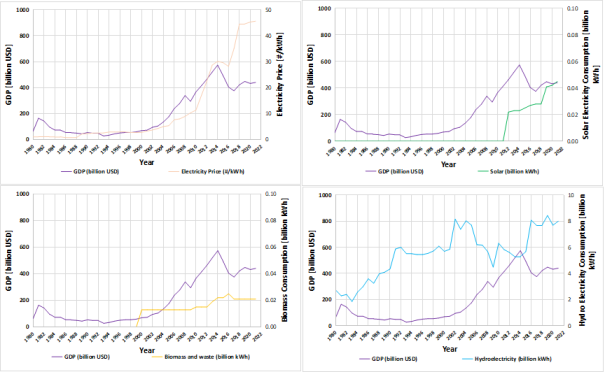
To visually inspect any possible co-movement between GDP, and electricity consumption from renewable electricity sources and electricity price, we plot the GDP, against each of the selected electricity consumption indexes and electricity prices (Figure 1). The evidence of possible interaction between GDP and electricity consumption seems obvious although it appears to be more pronounced for the non-renewable energy sources and hydroelectricity. As conventional for time series with large T, we subject the relevant variables to unit root test. We find that the various electricity consumption indexes are integrated of order zero [I(1)]. The unit root test results affirm the appropriateness of our choice of ARDL model as the preferred estimation framework in the context of this study.
Figure 1. Plot of GDP with electricity price, solar, hydro and biomass electricity consumption. Plot of GDP with electricity price, solar, hydro and biomass electricity consumption.
4.1. Unit Root Test
Table 2 shows the report of stationarity analysis carried out on the level I(0) and the first difference I(1) state representing none, constant and constant plus trend specification respectively. We observe from the level of significance, the rejection of the null hypothesis for the stationary model for the variables after taking the first difference.
Table 2. Augmented Dickey Fuller (ADF) Unit Root Analysis.

Variable

Level

None

First Difference

None

I(n)

Constant

Constant & Trend

Constant

Constant & Trend

LGDP

-0.3201

-2.8348

0.3400

-4.9999***

.-5.1828***

-4.9876***

I(1)

LSOL_EC

-0.2753

-1.8676

-1.2461

-6.3847***

-6.4662***

-6.2224***

I(1)

LHYDRO_EC

-1.5899

-2.1237

0.7274

-7.7392***

-7.7555***

-7.4603***

I(1)

LBIO_EC

-0.9855

-1.9971

-1.4158

-6.3377***

-6.2545***

-6.2444***

I(1)

LEPRICE

0.3056

-2.3985

2.4474

-5.7772***

-5.7907***

-4.8848***

I(1)

***, **, * Indicates the significant levels at 1%, 5%, and 10% respectively.
All variables were observed to be stationary at I(1) with 1% level of significance at constant, constant & trend and none specification indicating the presence of unit root, hence further test has to be performed to check for cointegration for each equation
4.2. Long Run Analysis and Bound Cointegration Test
After affirming the presents of unit root, the next step is to test for co-integration to determine presence on short run or long run equilibrium. Table 3 reports co-integration results of among variables using equation 4 for an Unrestricted constant and no trend specification model.
The result from the Bounds test shows that there is co-integration among the investigated variable, renewable electricity consumption sources, electricity price and the GDP of Nigeria as the F-statistics is greater than I(0) and I(1) bounds at 5% and 10% significance level. The exhibition of a long-run relationship among variables suggests that there are shocks even in the short-run which may affect movement in the individual series which converges with time in the long-run. Therefore, a long run and short run model should be specified.
The Error coefficient in the levels equation in Table 3 presents the long run form of the impact of renewable electricity consumption sources, electricity price and the GDP of Nigeria. The results of the error coefficient show that bio electricity consumption has a positive effect on the economic growth of Nigeria. This is because bio electricity consumption is statistically significant in 1%, 5% and 10% level of significance, we can say that 1% increase in bio electricity consumption in Nigeria will cause increase in development by approximately 0.14%. This result is in accordance with and .
Table 3. Long Run and Bounds Co-integration Test: Impact of Renewable Energy Consumption and Electricity Price on Gross Domestic Product (GDP).

Levels Equation

Case 3: Unrestricted Constant and No Trend

Variable

Coefficient

Std. Error

t-Statistic

Prob.

LSOLAR

0.014089

0.025978

0.542326

0.593

LHYDRO

-0.49154

0.462016

-1.063902

0.2989

LBIO

0.14097

0.019452

7.247055

0

LEPRICE

0.157449

0.226904

0.693904

0.495

EC = LGDP - (0.0141*LSOLAR - 0.4915*LHYDRO + 0.1410*LBIO + 0.1574*LEPRICE)

F-Bounds Test

Null Hypothesis: No levels relationship

Test Statistic

Value

Signif.

I(0)

I(1)

F-statistic

4.228297

10%

2.45

3.52

k

4

5.00%

2.86

4.01

3%

3.25

4.49

1%

3.74

5.06

Actual Sample Size

38

Finite Sample: n=40

4.3. Short Run Analysis
Table 4 present the short run OLS regression after estimating the error correction model from the long run residuals. These estimated values show that there is negative and significant impact of the difference in the log value of the first, second and third lag of bio electricity consumption and difference in the log value of the second lag of hydro electricity consumption on the GDP, while the difference in the log value of the current lag of solar and bio electricity consumption have positive impact on GDP at 10% and 1% significant levels respectively.
The coefficient of the Error Correction Term (-0.49) is negative with an absolute coefficient less than 1 and is also statistically significant at 1%, 5% and 10%. This implies that the effect of a surprise change in GDP is not temporary. Moreover, this result shows that the short-run change from the long-run equilibrium is corrected by 49% each year. This speed of adjustment is relatively slow. Therefore, it requires effective policy attention to drive gross domestic production (GDP) to long-run equilibrium.
Table 4. Short Run Analysis: Impact of Renewable Energy Consumption Renewable Energy Consumption and Electricity Price on Gross Domestic Product (GDP).

ECM Regression

Case 3: Unrestricted Constant and No Trend

Variable

Coefficient

Std. Error

t-Statistic

C

3.491499***

0.694627

5.026435

D(LSOLAR)

0.02439*

0.011995

2.03336

D(LHYDRO)

-0.152859

0.162281

-0.941935

D(LHYDRO(-1))

-0.034636

0.159178

-0.217592

D(LHYDRO(-2))

-0.529463***

0.150256

-3.523747

D(LBIO)

0.023914**

0.011014

2.171276

D(LBIO(-1))

-0.051848***

0.015172

-3.417374

D(LBIO(-2))

-0.032723*

0.015872

-2.061677

D(LBIO(-3))

-0.029437**

0.01364

-2.158108

D(LEPRICE)

-0.03766

0.113367

-0.332196

D(LEPRICE(-1))

0.187812

0.110005

1.707303

CointEq(-1)*

-0.491158***

0.09826

-4.998539

R-squared

0.678572

Mean dependent var

0.039815

Adjusted R-squared

0.542583

S. D. dependent var

0.181339

S. E. of regression

0.122644

Akaike info criterion

-1.106971

Sum squared resid

0.391081

Schwarz criterion

-0.589839

Log likelihood

33.03245

Hannan-Quinn criter.

-0.922979

F-statistic

4.989912

Durbin-Watson stat

1.999192

Prob(F-statistic)

0.000367

Judging by the Durbin Watson (DW) value which is mostly 2, shows that there is no evidence of serial correlation. Result of diagnostics test is presented in Table 5.
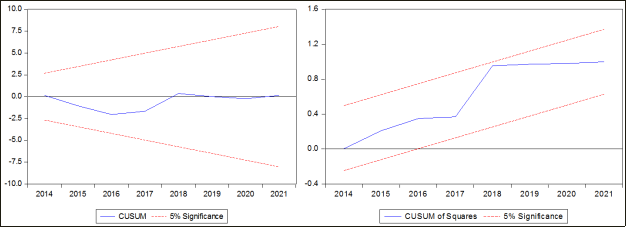
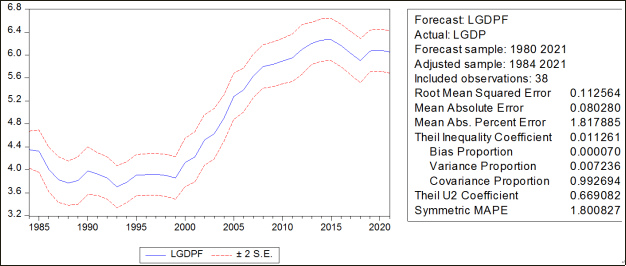
The diagnostics test in Table 5 shows that the model Output from the Ramsey reset test reports the test regression, the F-statistic for testing the hypothesis that the coefficients on the powers of fitted values from the regression are jointly zero, that is, the model is correctly specified. The null cannot be rejected since the p-value is more than 10%. Similarly, the model is also homoscedastic and has no serial correlation as the F-statistics of the ARCH and Breusch-Godfrey LM is not significant therefore the null hypothesis cannot be rejected. Normality test from the Jarque -Beara test shows the data are not normally distributed. The CUSUM test for stability is meant to determine the appropriateness and the stability of the model. Put differently, the CUSUM test is used to show whether the model is stable and is suitable for making long run decision. Figure 2 shows that the plot of CUSUM for the model under consideration is within the five per cent critical bound. This by implication suggests that the parameters of the model do not suffer from any structural instability over the period of study. That is, all the coefficients in the error correction model are stable. The CUSUM of Squares trend as show in Figure 2 also suggest the models is stable within the 5% critical bound. Model forecast performance (Figure 3) shows good trend with historic data set for GDP.
Table 5. Diagnostic Test: Impact of Renewable Energy Consumption Renewable Energy Consumption and Electricity Price on Gross Domestic Product (GDP).

Test

Test Type

F-Stat

Linearity

Ramsey RESET

1.575383

Heteroskedasticity

ARCH

0.389045

Serial Correlation

Breusch-Godfrey

0.043428

Normality

Jarque-Bera

31.3043***

***, **, * Indicates the significant levels at 1%, 5%, and 10% respectively.
Figure 2. CUSUM Test and CUSUM of Squares Test for GDP.
Figure 3. Model forecast performance for GDP.
4.4. Granger Causality Analysis
The study employs the granger causality test to examine whether the past values of a variable help in predicting current changes in the unrestricted VAR model or VECM. Table 6 displays the results of the Granger causality results. The results (Table 6) when GDP is the dependent variable shows that GDP causes solar electricity consumption and bio electricity consumption causes GDP at 5% and 10% significance level. The long-run results suggested a unidirectional causality flowing from GDP to solar electricity consumption and and from bio electricity consumption to economic growth measured by GDP.
Table 6. Granger Causality Analysis: Impact of Renewable Energy Consumption Renewable Energy Consumption and Electricity Price on Gross Domestic Product (GDP).

Null Hypothesis (H0):

F-Stat

Prob.

Decision

Causality

LSOLAR does not Granger Cause LGDP

0.01993

0.8885

Accept

LGDP does not Granger Cause LSOLAR

5.95432

0.0195

Reject

Unidirectional

LHYDRO does not Granger Cause LGDP

2.65005

0.1118

Accept

LGDP does not Granger Cause LHYDRO

0.00058

0.981

Accept

LBIO does not Granger Cause LGDP

7.24029

0.0105

Reject

Unidirectional

LGDP does not Granger Cause LBIO

0.00566

0.9404

Accept

LEPRICE does not Granger Cause LGDP

1.84911

0.1819

Accept

LGDP does not Granger Cause LEPRICE

0.27673

0.6019

Accept

LHYDRO does not Granger Cause LSOLAR

0.37703

0.5429

Accept

LSOLAR does not Granger Cause LHYDRO

1.01554

0.32

Accept

LBIO does not Granger Cause LSOLAR

3.46137

0.0706

Reject

Unidirectional

LSOLAR does not Granger Cause LBIO

0.00315

0.9556

Accept

LEPRICE does not Granger Cause LSOLAR

7.67155

0.0086

Reject

Unidirectional

LSOLAR does not Granger Cause LEPRICE

0.21753

0.6436

Accept

LBIO does not Granger Cause LHYDRO

0.61789

0.4367

Accept

LHYDRO does not Granger Cause LBIO

2.03855

0.1615

Accept

LEPRICE does not Granger Cause LHYDRO

1.06728

0.3081

Accept

LHYDRO does not Granger Cause LEPRICE

2.26312

0.1408

Accept

LEPRICE does not Granger Cause LBIO

0.5059

0.4813

Accept

LBIO does not Granger Cause LEPRICE

3.98185

0.0532

Reject

Unidirectional

4.5. Variance Decomposition
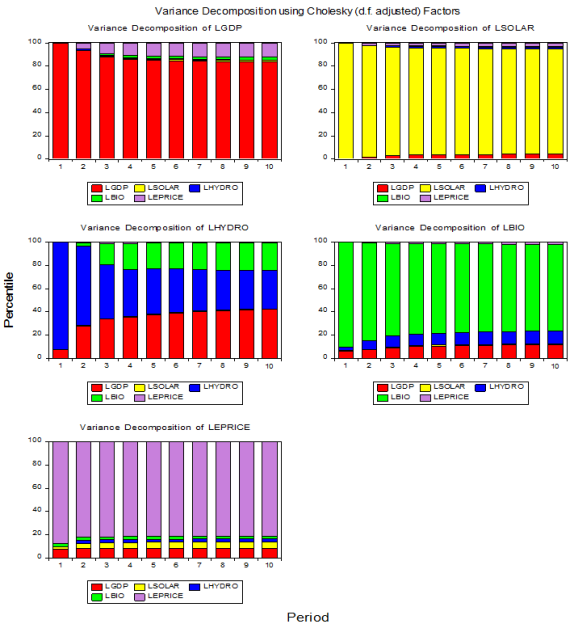
Variance decomposition explains the proportion of the forecast error variance that impacts its own shocks and the other variables in the unrestricted Vector Error Correction Model (VECM). Figure 4 presents the graph representations of variance decomposition renewable electricity consumption sources, electricity prices and the GDP of Nigeria.
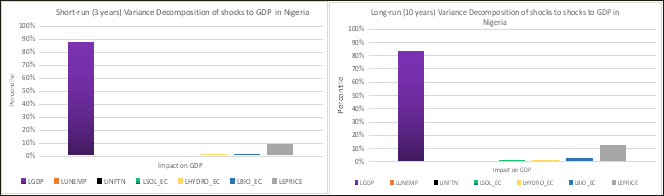
From the variance decomposition in the short-run (year 3), solar, hydro, biomass, electricity prices and GDP, accounts for 1%, 1%, 1%, 9% and 88% respectively for fluctuation in GDP (own shock). In the long-run (year 10), shocks to solar, hydro, biomass, electricity price and GDP, accounts for 1.4%, 0.4%, 2.2%, 12% and 83% respectively for fluctuation in GDP (own shock). However, in the short-run (year 3), solar, hydro, biomass, electricity prices and GDP, accounts for 93.3%, 1.3%, 0.24%, 2.4% and 2.7% respectively for fluctuation in solar electricity consumption (own shock).
In the long-run (year 10), shocks to solar, hydro, biomass, electricity price and GDP, accounts for 91%, 1.5%, 0.4%, 3.1% and 4% respectively for fluctuation in solar electricity consumption (own shock). Whereas, in the short-run (year 3), solar, hydro, biomass, electricity prices and GDP, accounts for 0.6%, 46.6%, 18%, 1.2% and 33.6% respectively for fluctuation in hydro electricity consumption (own shock).
In the long-run (year 10), shocks to solar, hydro, biomass, electricity price and GDP, accounts for 0.53%, 33%, 24%, 0.42% and 42% respectively for fluctuation in hydro electricity consumption (own shock). While in the short-run (year 3), solar, hydro, biomass, electricity prices and GDP, accounts for 0.5%, 10%, 79.1%, 1.3% and 9.1% respectively for fluctuation in biomass consumption (own shock).
In the long-run (year 10), shocks to solar, hydro, biomass, electricity price and GDP, accounts for 0.8%, 11%, 75%, 1.6% and 11.7% respectively for fluctuation in biomass consumption (own shock). whereas, in the short-run (year 3), solar, hydro, biomass, electricity prices and GDP, accounts for 5%, 3%, 3%, 82% and 8% respectively for fluctuation in electricity price (own shock). In the long-run (year 10), shocks to solar, hydro, biomass, electricity price and GDP, accounts for 6%, 3%, 2%, 82% and 8% respectively for fluctuation in electricity price (own shock).
These results from variance decomposition shows that electricity price, solar, biomass electricity consumption and GDP are strongly endogenous to itself. while hydro electricity consumption exhibits weak endogenous influence itself as GDP and biomass consumption exhibits strongly endogenous influence on hydro electricity consumption.
Figure 4. Variance Decomposition of GDP, Electricity Consumption from renewable sources and electricity price.
5. Discussion
The impact of electricity consumption on the economy of Nigeria was evaluated. The main determinants of Nigeria’s economy within the study period were Gross Domestic Product (GDP) as a function of electricity price and renewable energy sources such as solar electricity consumption, hydro power electricity consumption and biomass consumption. The unit root test performed using the Augmented Dickey Fuller (ADF) test on the level I(0) and the first difference I(1) state indicated the observe from the level of significance, the rejection of the null hypothesis for the stationary model for all the variables after taking the first difference. The Bounds Cointegration test also shows that there is co integration between the various variables therefore long run and short run model relationship between the dependent variables (Gross Domesticc Product GDP) and the independent variables (electricity price and renewable energy sources such as solar electricity consumption, hydro power electricity consumption and biomass consumption) were estimated. The unit root and cointegration tests were consistent with findings of other research works .
The long run analysis for impact on GDP showed that biomass consumption displays significant and positive impact on the economic growth of Nigeria measured by the GDP. The impact on GDP in the short run was mostly insignificant like the report by Chitedze et al , with only solar electricity consumption having a significant and positive impact to cause a 0.02% increase in GDP for a 1% increase is solar electricity consumption. The coefficient of the Error Correction Term (ECT) in the short run is negative with an absolute coefficient less than 1and is also statistically significant at 1%, 5% and 10%. The implication is that the effect of a surprise change in GDP is not temporary. Moreover, this result shows that the short-run change from the long-run equilibrium is corrected by approximately 49% each year. The diagnostic test from the probability values of the F-statistics shows that the model is linear, homoskedastic and has no serial correlation. The stability diagnostics using CUSUM and CUSUMSQ indicates that the models are suitable for forecasting.
Granger causality test results suggest long-run unidirectional causality from biomass consumption to GDP. This one-way causality indicates biomass consumption is a driver for Nigeria’s economic development, however this may cause inefficiencies due to economics of scale and environment considerations. A unidirectional causality also flows from GDP to solar electricity consumption. The underdevelopment of solar electricity markets as well as demand for foreign goods and capital to purchase solar electricity products may have driven these results.
Table 7. Summary of Long and Short Run Impact compared to an Ideal Growing Economy.

Variable

Long Run Impact

Short Run Impact

GDP

GDP

Growing Economy

Increase

Increase

LSOL_EC

Not significant**

Increase**

LHYDRO_EC

Not significant

Decrease

LBIO_EC

Increase*

Mixed*

LEPRICE

Not significant

Not significant

* Unidirectional causality from independent variable to dependent variable
** Unidirectional causality from dependent variable to independent variable
Figure 5. Short run and Long run Variance Decomposition of GDP, Electricity Consumption from Renewable sources and Electricity price.
Variance decomposition analysis (Figure 5) indicates that GDP is strongly endogenous and for the Nigerian economy, shocks to GDP cannot be explained by renewable energy consumption or by electricity prices.
6. Conclusions
The objective of the study was to Position Nigeria for economic growth through energy transition using a case study of renewable energy consumption. By so doing econometric models were used. The data analyzed in this study was obtained from the World Bank and the US Energy Information Administration (EIA). The econometric model study explains the effects of electricity prices and electricity consumption from renewable energy sources the economy of Nigeria through the investigation of electricity consumption from renewable energy sources, and macroeconomic relationship using an unrestricted vector error correction model (VECM) during the period (1980 - 2021).
A growing economy above all others is characterized with an increasing gross domestic product (GDP). The study findngs indicate that increase in solar electricity consumption tends to increase GDP while Hydro electricity consumption impacts GDP is negatively. This is possible due to the uncertainties in the Nigerian electricity market. Increase in biomass consumption tends to increase GDP on the long run with mixed impact on the short run. This is because of the local use of fuel wood as substitutes to gas and petrol whose prices are volatile could reduce inflation by cutting demand and government expenses on importation of petrol in country. According to Maji, Chindo, & Rahim , renewable energy use can slow down economic growth by lowering productivity when unclean, inefficient sources and process are used this observation is also supported by the study of Ebube & Akan . Therefore, regulations need to be put in place to control the adverse effect on the environment which could cause mixed impact on gross domestic product in the short run.
Abbreviations

ARDL

Auto Regressive Distributed Lag

GDP

Gross Domestic Product

CRW

Combustible Renewable Waste

ADF

Augmented Dickey Fuller

VECM

Vector Error Correction Model

EIA

Energy Information Administration

LSOL_EC

Log of Solar Electricity Consumption

LHYDRO_EC

Log of Hydro Electricity Consumption

LBIO_EC

Log of Biomass Consumption

LEPRICE

Log of Electricity Proce

DOLS

Dynamic Ordinary Least Squares

OLS

Ordinary Least Squares

ECM

Error Correction Moded

VAR

Vector Auto Regressive

Author Contributions
Ebube Orisa: Conceptualization, Data curation, Investigation, Formal analysis, Resources, Methodology, Writing – original draft, Writing- review & editing.
Anthony Ibe: Supervision, Project administration, Validation, Writing – reviewing & editing.
Alwell Nteegah: Supervision, Validation, Writing – reviewing & editing.
Funding
This work is not supported by any external funding.
Data Availability Statement
The data supporting the outcome of this research work has been reported in this manuscript and is available from the corresponding author upon reasonable request.
Conflicts of Interest
The authors declare no conflicts of interest.
References
[1] Fotourehchi, Z. Renewable Energy Consumption and Economic Growth: A Case Study for Developing Countries. International Journal of Energy, Economics and Policy. 2017, 7(2), 61-64.
[2] IEA. World Energy Outlook. Paris, France: International Energy Agency. 2009, Retrieved from
[3] Ebube, O. F., Akan, E. E. The Other Side: Negative Impacts of Exploiting Renewable Energy Sources. European Journal of Engineering and Technology Research. 2021, 6(3), 30–33.
[4] Shahid. A, Zhang, J., Azeem, A., Mahmood, A. Impact of electricity consumption on economic growth: an application of vector error correction model and artificial neural networks. The Journal of Developing Areas. 2020, 54(4).
[5] Jacobo, C., Viviana S. The relationship between energy consumption and GDP: evidence from a panel of 10 Latin American countries." Latin American Journal of Economics. 2013, 50(2), pp. 23.
[6] Westerlund, J. Testing for panel cointegration with multiple structural breaks. Oxford Bulletin of Economics and Statistics. 2006, 68: 10132.
[7] Kammen, D. M., Pless, J.. Beyond Technology: Demand-Side Solutions for Climate Change Mitigation. Annual Review of Environment and Resources. 2007, 32, 271-293.
[8] Kaldellis, J. K., Kapsali, M. Optimum Sizing of Small Photovoltaic-Based Hybrid Power Stations for Various Greek Load Profiles. Applied Energy. 2013, 101, 103-118.
[9] Fthenakis, V., et al. Technical and Economic Feasibility of Central-Station Photovoltaic Power Plants for Application in the Sundrenched Desert Regions. Progress in Photovoltaics: Research and Applications. 2009, 17(2), 125-135.
[10] IEA. Global Energy Review 2019, IEA, Paris. Available from
[11] Karekezi, S., Kithyoma, W. Renewable Energy Strategies for Rural Africa: Is a PV-led Renewable Energy Strategy the Right Approach for Providing Modern Energy to the Rural Poor of Sub-Saharan Africa? Energy Policy. 2002 30(11-12), 1071-1086.
[12] Asafu-Adjaye, J. The relationship between energy consumption, energy prices, and economic growth: Time series evidence from Asian developing countries. Energy Economics. 2000, 22(6), 615-625.
[13] Lee, C. C., Chang, C. P. Energy consumption and GDP revisited: A panel analysis of developed and developing countries. Energy Economics. 2008, 30(6), 2349-2359.
[14] Wolde-Rufael, Y. Electricity consumption and economic growth: A time series experience for 17 African countries. Energy Policy. 2006, 34(10), 1106-1114.
[15] Apergis, N., Payne, J. E. Renewable energy consumption and economic growth: Evidence from a panel of OECD countries. Energy Policy. 2010, 38(1), 656-660.
[16] Nwosa, P., Akinbobola, T. Aggregate Energy Consumption and Sectoral Output in Nigeria. African Research Review. 2012, 6(4) pp 206-215.
[17] Chitedze, I., Nwedeh, C. C., Adeola, A., Abonyi, D. C. An econometric analysis of electricity consumption and real sector performance in Nigeria. International Journal of Energy Sector Management. 2021, 15(4), pp 855-873.
[18] Apergis, N., Payne, J. E. The renewable energy consumption–growth nexus in Central America. Applied Energy. 2011, 88(1), 343-347.
[19] Narayan P. K., Popp S. The energy consumption-real GDP nexus revisited: Empirical evidence from 93 countries. Economic Modelling. 2012, 29, pp 303-308.
[20] Marinaș M. C., Dinu M., Socol A. G., Socol C. Renewable energy consumption and economic growth. Causality relationship in Central and Eastern European countries. 2018, 13(10): e0202951.
[21] Maji, I., Sulaiman C., Rahim A. Renewable energy consumption and economic growth nexus: A fresh evidence from West Africa. Energy Reports. 2019, 5
[22] Jebli, B. M., Ben Y. S. Economic growth, combustible renewables and waste consumption, and CO2 emissions in North Africa. Environmental Science and Pollution Research. 2022, 22, 16022–16030.
[23] Amri, F. Intercourse across economic growth, trade, and renewable energy consumption in developing and developed countries. Renewable and Sustainable Energy Reviews. 2017, 69, pp. 527- 534.
[24] Abdalla, A. N., Jing, W., Nazir, M. S., Jiang, M., Tao, H. Socio-economic impacts of solar energy technologies for sustainable green energy: a review. Cleaner Engineering and Technology. 2023, 25, 13695-137325.
[25] Rafal K. Electricity consumption and economic growth: Evidence from Poland. Journal of International Studies. 2014, 7(1).
[26] Ohler, A., Fetters, I. The causal relationship between renewable electricity generation and GDP growth: A study of energy sources. Energy Economics. 2014, 43 pp, 125-139.
Cite This Article
  • APA Style

    Orisa, E., Ibe, A., Nteegah, A. (2024). Impact of Energy Consumption from Renewable Energy Sources on Economic Growth: Evidence from Nigeria. Journal of Energy and Natural Resources, 13(4), 138-151. https://doi.org/10.11648/j.jenr.20241304.11

    Copy | Download

    ACS Style

    Orisa, E.; Ibe, A.; Nteegah, A. Impact of Energy Consumption from Renewable Energy Sources on Economic Growth: Evidence from Nigeria. J. Energy Nat. Resour. 2024, 13(4), 138-151. doi: 10.11648/j.jenr.20241304.11

    Copy | Download

    AMA Style

    Orisa E, Ibe A, Nteegah A. Impact of Energy Consumption from Renewable Energy Sources on Economic Growth: Evidence from Nigeria. J Energy Nat Resour. 2024;13(4):138-151. doi: 10.11648/j.jenr.20241304.11

    Copy | Download

  • @article{10.11648/j.jenr.20241304.11,
      author = {Ebube Orisa and Anthony Ibe and Alwell Nteegah},
      title = {Impact of Energy Consumption from Renewable Energy Sources on Economic Growth: Evidence from Nigeria
    },
      journal = {Journal of Energy and Natural Resources},
      volume = {13},
      number = {4},
      pages = {138-151},
      doi = {10.11648/j.jenr.20241304.11},
      url = {https://doi.org/10.11648/j.jenr.20241304.11},
      eprint = {https://article.sciencepublishinggroup.com/pdf/10.11648.j.jenr.20241304.11},
      abstract = {This study examines the impact of renewable energy consumption and electricity tariff on the economy of Nigeria. The study considers the casual relationship and vector decomposition between various renewable energy sources (solar, hydro and biomass), electricity price and Gross domestic product (GDP) using an unrestricted vector error correction model (VECM). In addition, other robust econometric techniques were applied to the time series of GDP, electricity price and energy consumption from renewable energy sources from 1980 to 2021. The findings indicated a 1% increase in biomass consumption causes increase in GDP by 0.14% in the long-run. Mixed result in the short-run with the difference in the log value of the current lag of solar and bio electricity consumption having positive impact on GDP. The coefficient of the Error Correction Model (ECM) was negative (-0.49) and statistically significant indicating that short-run change from the long-run equilibrium is corrected by 49% annually. Unidirectional causality from GDP to solar electricity consumption. Solar, hydro, biomass and electricity price explain 1.4%, 0.4% 2.2% & 12% respectively of fluctuations in GDP in the long-run. The study results demonstrates that regulations need to be put in place to control the adverse effect of consuming biomass on the environment which could cause mixed impact on gross domestic product in the short run whereas, policies to foster development of solar projects could impact positively on GDP and alleviate the electricity supply deficiency in Nigeria.},
     year = {2024}
    }
    

    Copy | Download

  • TY  - JOUR
    T1  - Impact of Energy Consumption from Renewable Energy Sources on Economic Growth: Evidence from Nigeria
    
    AU  - Ebube Orisa
    AU  - Anthony Ibe
    AU  - Alwell Nteegah
    Y1  - 2024/10/29
    PY  - 2024
    N1  - https://doi.org/10.11648/j.jenr.20241304.11
    DO  - 10.11648/j.jenr.20241304.11
    T2  - Journal of Energy and Natural Resources
    JF  - Journal of Energy and Natural Resources
    JO  - Journal of Energy and Natural Resources
    SP  - 138
    EP  - 151
    PB  - Science Publishing Group
    SN  - 2330-7404
    UR  - https://doi.org/10.11648/j.jenr.20241304.11
    AB  - This study examines the impact of renewable energy consumption and electricity tariff on the economy of Nigeria. The study considers the casual relationship and vector decomposition between various renewable energy sources (solar, hydro and biomass), electricity price and Gross domestic product (GDP) using an unrestricted vector error correction model (VECM). In addition, other robust econometric techniques were applied to the time series of GDP, electricity price and energy consumption from renewable energy sources from 1980 to 2021. The findings indicated a 1% increase in biomass consumption causes increase in GDP by 0.14% in the long-run. Mixed result in the short-run with the difference in the log value of the current lag of solar and bio electricity consumption having positive impact on GDP. The coefficient of the Error Correction Model (ECM) was negative (-0.49) and statistically significant indicating that short-run change from the long-run equilibrium is corrected by 49% annually. Unidirectional causality from GDP to solar electricity consumption. Solar, hydro, biomass and electricity price explain 1.4%, 0.4% 2.2% & 12% respectively of fluctuations in GDP in the long-run. The study results demonstrates that regulations need to be put in place to control the adverse effect of consuming biomass on the environment which could cause mixed impact on gross domestic product in the short run whereas, policies to foster development of solar projects could impact positively on GDP and alleviate the electricity supply deficiency in Nigeria.
    VL  - 13
    IS  - 4
    ER  - 

    Copy | Download

Author Information
  • Emerald Energy Institute, University of Port Harcourt, Choba, Nigeria

    Biography: Ebube Orisa is a Ph. D. scholar of Energy Economics at the Emerald Energy Institute. He completed his First Degree in Petroleum Engineering from the Rivers State University, and he holds a Master’s in petroleum engineering and project Development from the Institute of Petroleum and Energy Studies (IPES), IFP/Uniport. He has participated in multiple international research collaboration projects in areas of Petroleum Engineering and Energy Economics. He is a member of Nigerian Society of Engineers (NSE) and the Society of Petroleum Engineers (SPE) where he volunteers for the Port Harcourt section. His research interest is in Reservoir engineering, Energy and Petroleum Economics, Renewable Technologies, Production and Operation Monitoring Optimization.

    Research Fields: Reservoir Engineering, Energy Economics, Petroleum Economics, Renewable Energy, Production Optimization, Petroleum Engineering

  • Department of Electrical/Electronic Engineering, University of Port Harcourt, Choba, Nigeria

    Biography: Anthony Ibe holds a B. Eng, 1st Class honours (1979) from University of Nigeria, Nsukka and a PhD, DIC (1984) from Imperial College of Science and Technology, London. Prof. Ibe is a member of Nigerian Society of Engineers (NSE) and a Senior Member, Institute of Electrical and Electronic Engineers (IEEE). He is also a COREN registered Engineer. He has published over 40 articles and four books in Electrical Engineering. He has supervised over 50 masters’ degree students and PhD students. Prof. Ibe is an external examiner and assessor to a couple of Universities within and outside Nigeria.

    Research Fields: Energy Economics, Petroleum Economics, Renewable Energy, Power Systems, Electrical Electronics Engineering

  • Department of Economics, University of Port Harcourt, Choba, Nigeria

    Biography: Alwell Nteegah is a Senior Lecturer in the Department of Economics at the University of Port Harcourt., Nigeria. He holds a Master’s and PhD degree in Economics. He has published over 50 articles in Economics. He has supervised over 50 masters’ degree students and PhD students.

    Research Fields: Energy Economics, Petroleum Economics, Renewable Energy, Econometrics, Macro and Microeconomics, Banking and Finance